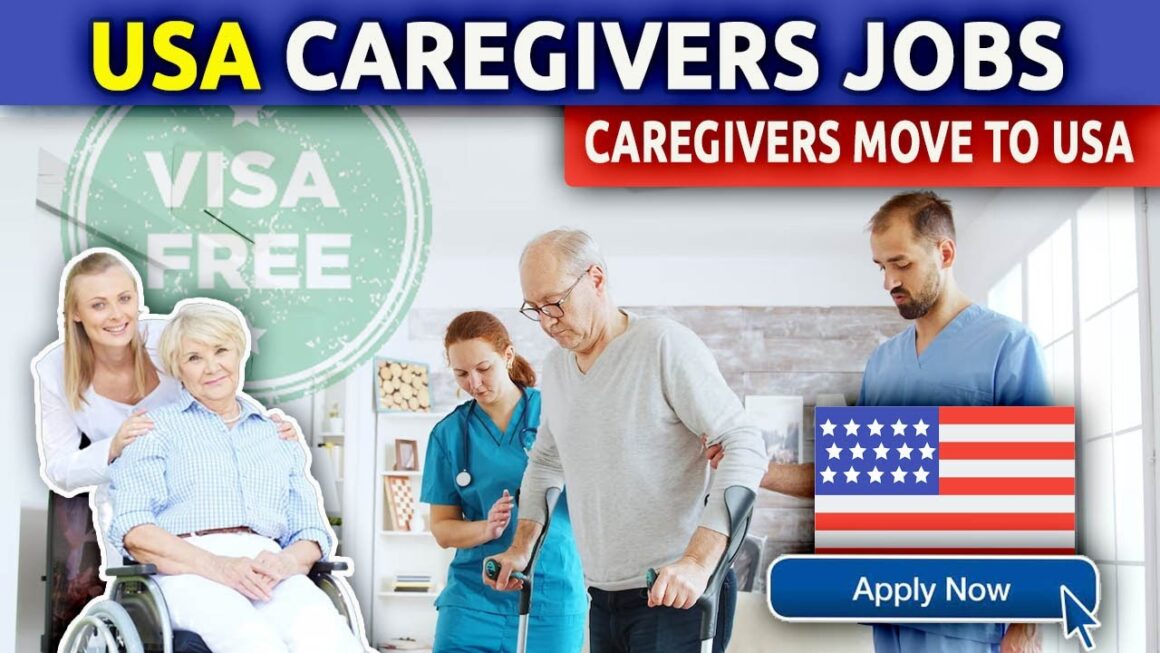
Caregiver roles in the United States—often advertised as home health aide, personal care aide, nursing assistant, companion, direct support professional, or resident care aide—are in steady demand because of an aging population and rising need for in-home support. That demand has also created a lot of confusion (and unfortunately, scams) around “caregiver visa sponsorship.”
Here is the most important truth upfront: the United States does not have a single, dedicated “caregiver visa.” Caregiver hiring typically happens through general U.S. work visa pathways (temporary or permanent), each with strict employer requirements and eligibility rules. (Congress.gov)
This article explains the realistic sponsorship routes, what “visa sponsorship” actually means, how to qualify, how to find legitimate employers, and how to avoid common traps.
1) What “visa sponsorship” really means in the U.S.
When a U.S. employer says “visa sponsorship,” it generally means the employer is willing to do some combination of the following:
- File immigration petitions (for example, Form I-140 for a green card route, or Form I-129 for certain temporary worker categories).
- Run required labor steps showing the job is legitimate and that U.S. workers are not being displaced (often involving the U.S. Department of Labor).
- Pay required government and compliance costs (varies by program; legitimate employers do not push all costs onto workers).
- Provide documentation so the worker can apply for a visa at a U.S. embassy/consulate (if outside the U.S.), or change/adjust status (if already in the U.S.).
For caregiver roles, sponsorship most commonly appears in two broad forms:
- Permanent sponsorship (green card) via EB-3 (including “Other Workers” roles that require less than 2 years of training/experience). (USCIS)
- Temporary sponsorship via H-2B in limited cases (only where the employer can prove the job is truly temporary/seasonal/one-time need). (USCIS)
2) The main visa pathways for caregiver-type jobs
A. EB-3 “Other Workers” (permanent residence / green card route)
For many caregiver candidates abroad, EB-3 is the pathway most often discussed because it can lead to a green card if an employer completes the process.
What EB-3 is: The U.S. government’s “Employment-Based Third Preference” category includes “Other Workers” for roles requiring less than 2 years of training or experience. (USCIS)
Why it can fit caregiver roles: Many entry-level caregiver jobs are trained on the job or through short certification programs. However, “fit” does not mean “easy”—the employer must still complete required steps (including labor certification in many cases).
High-level EB-3 flow (typical):
- Employer completes the labor process (often labor certification) and demonstrates the job and recruitment requirements.
- Employer files Form I-140 (Immigrant Petition for Alien Worker).
- Worker completes consular processing (abroad) or adjustment of status (in the U.S., if eligible).
The U.S. Department of State’s overview confirms that EB-3 generally requires an approved I-140 and typically labor certification. (Travel.gov)
Best for: People seeking longer-term settlement and a stable work authorization pathway.
Limitations to understand:
- Processing times can be long (and vary by country and visa bulletin availability).
- Not every care agency is willing or able to sponsor.
- Job descriptions must be consistent and defensible under the rules (employers can’t “invent” requirements just to fit a candidate).
B. H-2B (temporary non-agricultural work) — limited fit for caregiving
H-2B lets U.S. employers hire foreign workers for temporary non-agricultural needs. The program requires a Department of Labor labor certification step and then an employer petition to USCIS. (USCIS)
Core issue for caregivers: Most caregiving is ongoing, year-round, not “temporary” in the way H-2B expects. H-2B can work only where an employer can prove the need is temporary (seasonal peak, one-time occurrence, intermittent, or short-term) under the program’s standards.
H-2B has an annual cap set by Congress (with limited supplemental allocations in some years). (USCIS)
Best for: Truly temporary caregiving-adjacent staffing needs (rare compared with hospitality, landscaping, etc.).
C. J-1 Au Pair (childcare) — not eldercare
If your goal is childcare rather than eldercare, the au pair model is a different structure typically under the J-1 exchange visitor framework (through designated sponsors). This is not the same as “caregiver jobs in the USA” for older people, and it has specific program rules and cultural exchange requirements.
D. Domestic worker options tied to specific employer situations (narrow use cases)
There are narrow visa categories used when someone is employed as a domestic worker for certain employers (for example, diplomats or certain international organizations). These are not general caregiver hiring channels and usually do not apply to typical home care agency jobs. (If this is your situation, you should get qualified legal advice.)
3) What kinds of “caregiver jobs” can qualify for sponsorship?
In practice, caregiver sponsorship postings usually map to one of these job families:
- Home Health Aide (HHA)
- Personal Care Aide (PCA)
- Certified Nursing Assistant (CNA) / Nurse Aide
- Direct Support Professional (DSP) (often disability services)
- Companion / Attendant / Resident Care Aide
A key point: the job title alone doesn’t decide the visa—the employer’s business model, the job’s requirements, and whether the role can meet a visa program’s criteria determine feasibility.
4) Basic qualifications employers look for (even before visa conversations)
While each employer differs, most U.S. caregiving employers screen for:
- English communication (for safety, instructions, documentation, and patient interaction).
- Background suitability (clean record, strong references, reliability).
- Trainability and empathy (the work is physically and emotionally demanding).
- Relevant training or certification (varies by state and employer):
- Many agencies train HHAs/PCAs internally.
- Some roles strongly prefer or require CNA credentials, especially in facilities.
Also expect requirements like CPR training, basic first aid, and readiness to work shifts.
5) Pay, hours, and what “prevailing wage” means for sponsored roles
If an employer sponsors through programs involving the U.S. Department of Labor, wage rules matter. In several employment-based contexts, the employer must meet wage requirements tied to the role and location.
The Department of Labor defines prevailing wage as the average wage paid to similarly employed workers in a specific occupation in the area of intended employment. (DOL)
What this means for you:
- The wage you are offered should be consistent with the job, the location, and legal minimums.
- Be cautious of offers that look unrealistic (either too low to be legal/credible or too high to be believable).
6) Step-by-step: how EB-3 caregiver sponsorship typically works (practical view)
Below is a practical, simplified view of how the EB-3 route often unfolds for entry-level care roles.
Step 1: Find a real employer with a real job need
This sounds obvious, but it is where many people get trapped. A legitimate employer will have:
- A verifiable U.S. business presence,
- Real job postings,
- A history of hiring,
- Clear terms of employment.
Step 2: Employer confirms the role fits EB-3 “Other Workers” or other EB-3 subcategory
USCIS outlines EB-3 as a third-preference employment-based classification. (USCIS)
Many caregiver roles are discussed under “Other Workers” (less than 2 years of training/experience), but the employer must structure the role correctly and follow the process.
Step 3: Employer completes the required labor steps
The U.S. Department of State notes EB-3 workers generally require labor certification approved by the Department of Labor. (Travel.gov)
Step 4: Employer files the immigrant petition (I-140)
Once the labor step is cleared (where required), the employer files the petition.
Step 5: Consular processing (if you are outside the U.S.) or adjustment (if eligible in the U.S.)
If outside the U.S., you attend the interview at a U.S. embassy/consulate when your case is ready.
Important: If anyone promises you “2 weeks to USA” or “guaranteed approval,” treat that as a major warning sign.
7) Step-by-step: how H-2B caregiving-adjacent sponsorship works (when it exists)
USCIS describes the H-2B process in three main stages: labor certification with DOL, petition with USCIS, then visa/entry. (USCIS)
A realistic H-2B pathway looks like:
- Employer applies for temporary labor certification (DOL step).
- Employer files Form I-129 with USCIS after DOL approval.
- Worker applies for the visa at a U.S. consulate (if abroad), then enters and works for that employer.
Key caution: H-2B is capped annually. (USCIS)
Also, H-2B is designed for temporary need, which limits caregiver applicability.
8) Where to find legitimate caregiver sponsorship opportunities
Use a layered approach:
A. Reputable job boards (screen carefully)
Large job boards sometimes show “visa sponsorship” filters, but many listings are vague or misleading. Treat them as lead sources only—then verify the employer carefully.
Example: some listings explicitly state sponsorship limitations (e.g., only for people already holding specific status), which is a reminder to read the fine print. (Indeed)
B. Licensed home care agencies and facility operators
Look for established:
- Home care agencies
- Assisted living operators
- Senior living communities
- Disability services providers
Then check:
- Company website,
- Address and registration,
- Reviews and complaints patterns,
- Hiring page consistency.
C. Use government and official references to verify claims
When an employer (or recruiter) mentions a visa path, compare their claims to official sources:
- USCIS pages for EB-3 and H-2B (USCIS)
- U.S. Department of State visa descriptions for employment-based immigration (Travel.gov)
- U.S. Department of Labor wage and foreign labor resources (DOL)
If their story contradicts official program structure, walk away.
9) Common scams in “caregiver visa sponsorship” (and how to avoid them)
Because caregiving is a high-demand, emotionally appealing field, scammers use it heavily. Watch out for:
- “Guaranteed visa” or “no interview needed.” Not credible.
- Upfront “job slot fee” to a personal bank account. High risk.
- Fake “caregiver visa program” websites using government logos or similar names.
- No real employer details (no address, no EIN, no corporate footprint).
- Pressure tactics: “Pay today or you lose your slot.”
A legitimate process is documentation-heavy, slow, and formal. It does not require secrecy or urgency pressure.
10) How to improve your chances of getting sponsored (practical, ethical steps)
If you want to be competitive for U.S. caregiver roles, focus on employability first:
- Build a care portfolio: training certificates, reference letters, short personal statement, and any volunteer or paid caregiving experience.
- Get basic care certifications where available (CPR/First Aid, older people care fundamentals).
- Prepare a U.S.-style resume emphasizing:
- Reliability,
- Shift flexibility,
- Client safety,
- Communication.
- Practice interview questions on:
- Handling emergencies,
- Medication reminders (within scope),
- Dementia behaviors,
- Personal care boundaries,
- Documentation and reporting.
- Be realistic about entry pathways: sponsorship is competitive, and many employers prefer candidates already authorized to work.
11) Documentation checklist (typical)
Exact requirements depend on the employer and visa route, but commonly requested items include:
- Passport bio page
- Updated CV/resume
- Certificates (training, caregiving, CPR/First Aid, CNA if applicable)
- Police clearance or background checks (country-specific)
- Reference letters
- Proof of relevant work history (where available)
For the visa process itself, follow the employer’s immigration counsel and official embassy instructions.
Conclusion
“Caregiver jobs in the USA with visa sponsorship” is a real goal, but it is often misunderstood. There is no special caregiver visa, so sponsorship typically happens through broader pathways—most commonly EB-3 for permanent roles, and more rarely H-2B for truly temporary needs. (Congress.gov)
Your winning strategy is to (1) target legitimate employers, (2) understand which visa route actually fits the job, (3) strengthen your caregiving profile with credible training and references, and (4) avoid “guaranteed visa” schemes. If an offer cannot be reconciled with the official USCIS/DOS/DOL rules, it is safer to walk away.
FAQs
1) Is there a specific “caregiver visa” for the USA?
No. The U.S. does not have a dedicated caregiver-only visa category; caregivers generally use broader employment-based immigration routes. (Congress.gov)
2) What is the most common visa sponsorship route for caregivers?
The most commonly discussed long-term route is EB-3 (often under “Other Workers” for roles requiring less than 2 years of training/experience), where a U.S. employer sponsors a green card case. (USCIS)
3) Can I get a temporary visa (like H-2B) for caregiver work?
Sometimes, but it is limited. H-2B is for temporary non-agricultural needs and requires a structured process (DOL step, then USCIS petition). Many caregiving roles are ongoing, which makes H-2B a poor fit in many cases. (USCIS)
4) How do I know if a caregiver sponsorship offer is real?
Verify the employer (real business footprint), demand written details, and cross-check the claimed visa path against official USCIS and Department of State guidance. Be wary of guarantees and upfront payments to individuals. (USCIS)
5) Do sponsored jobs have to meet a wage requirement?
Often yes, depending on the program. The U.S. Department of Labor’s prevailing wage concept ties wages to occupation and location in many foreign labor contexts. (DOL)